ABRAHAM'S PILGRIMAGE
OF FAITH
THE SAGA OF A HEROIC EARTHLING;
SIMILAR
TO OURS
The seed of Abraham in the natural sense goes through
the whole Old Testament; in the spiritual
sense it pervades the New Testament
(cf.
Gen. 15; Rom. 4). Abraham, a living
monument manifesting the all-around
aspects of divine-human relationships
was assuaged by YAHWEH, "Fear
not, Abram, I am your shield; your reward
shall be great" (Gen. 15:1). The person who showed us how to trust in the
Almighty experienced moments of fear:
When he took his departure from the
land of Canaan and went to Egypt (Gen.
12: 11-13; cf. 20:11).
When he could not quite submit
to YAHWEH's irrevocable assurances and
resorted to a primitive expedience (Gen.
15:2,3; 16:1-4). When he hesitated to send Hagar and Ishmael
away (Gen.
21:11,12).
But as Abram matured fear gave way to fortitude.
This is evident in that climactic
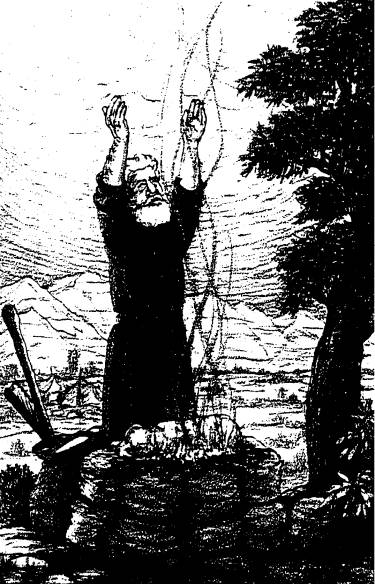
altar-building on Mount Moriah (YAH
Provides; Gen. 22:9).
By this time perfect love to
his LORD had rid him of all fear (I John 4:18). Deliverance
from this tormenting master is a delightful
awareness. God’s goal for the person submitted to his all-satisfying
will is to liberate him from fear’s
agony. Moving on with the Almighty and at the same
time entertaining that chilling intruder
that trepidates the whole being is a
contradiction in terms.
Aborting fear from the mind must
be the Christian’s prime aim. Its intransigent torture surpasses that of all other emotions.
Its unnecessary distress can
only be cured supernaturally.
Abraham wrestled with it until
he could say "Here
am I!" (Gen. 22:1).
This is Abraham at the apex of his spiritual pilgrimage,
the patriarch we can readily emulate. Abraham's journey is an education and exhortation to everyone starting
his pilgrimage with the mighty Savior. Abraham is a mobile believer with purpose and a definite destination.
Essentially, life is a journey.
We need to examine Abraham's life tenure
in his relationship to God.
Four geographic locations can
be observed in his sojourn.
Pertinent specifics accrue from
these for the design of our own pilgrimage.
I. THE HAMSTRUNG LIFE IN UR
(Gen. 11:27,28;
Acts 7:2,3)
The family of Terah constituted a renowned community
of relatives in Ur, a well developed
center of commerce and culture in Mesopotamia.
According to some authorities
it was in the land of Shinar (Gen.
10:10). In 2000 B.C. (c.) we meet them in Ur, concentrated in heightened
business ventures. According to a Middle
Eastern tradition, they were involved
in manufacturing and selling idols —
a ludicrous trade in the ancient world.
They had no concept of the living YAHWEH
(cf. Joshua 24: 2). This had
to come through special revelation.
Originally God's revelation of Himself and His summons
came to Abram, through whom it was extended
to the whole family (11:31; Acts 7:2,3). Terah, Abram's father, led them as patriarch
of the family.
Haran died in Ur; however Lot
his son joined the clan who received
YAHWEH's call to a new land and a new
life.
Their God-appointed destination:
Canaan,
the land of promise, flowing with milk
and honey.
What a striking resemblance to
God's summons for sinners—both men and
women—to abandon the life of transgression
and ignorance, and move out from a meaningless,
directionless existence to a life of
definite purpose and goal.
Abram and his family lived separated from the Creator-Redeemer
God in idolatrous Ur.
So does the natural person who
has no room for spiritual dimension
in his life (cf.
Is. 59:2). To the redeemed He says, "I am YAHWEH who brought you from Ur..." (Gen. 15:7).
The Savior, who rescues the sinner out
of slavery to sin, intends to steer that
person to the Promised Land. Abram and
his family were to take a geographical
journey.
The person, who through the conviction of the Holy Spirit turns his
back on sin, is set by grace on a spiritual
journey to Canaan.
He is to live the life of sanctification and
full appreciation of God, continuously
conscious of His sovereign guidance.
Canaan is not heaven as certain songs in our hymnody
erroneously have it!
No, Canaan is the fulfilled life
for every believer who abandons idolatrous
Ur for the surpassing worth of knowing
Christ Jesus our Lord.
In the New Testament it is described as the domain
of the spiritual person (pneumatikòς άnqrwpoς), over against the person described as natural — unspiritual or soulish
— (yuciκòς
άnqrwpoς, cf. I Cor. 2:14,15). The journey of faith is an
onward march from the natural to the
spiritual. It may be termed as the valor of faith, which removes the sinner
from Ur and takes him to Canaan.
The soulish
being is a dweller of Ur.
There is neither spirit, nor
any spiritual discernment in this individual. The person may have a form of religion or be
totally secular; but he is void of any
touch with the supernatural God who
commands the sinner to believe in the
Savior and by His grace become a pilgrim
in the march of faith. Unless the sinner
repents of his former life, allowing
Jesus Christ to save and put him on
the fascinating road of deliverance,
he will carry on a natural existence.
With only his soul being active,
he will perish in Ur.
Abram and his family honored the summons of the Almighty.
They were led by His sovereign
will and purpose (cf.
Joshua 24:2,3).
The valor of faith was theirs.
The Savior of humankind stressed
the necessity of the new birth, both
for the religious and irreligious.
"Truly, truly, I say to you, unless one is born anew, he cannot see
the kingdom of God" (John 3:3).
Saul of Tarsus, rescued from
a life of spite, hatred and malignity,
puts this divine execution in poignant
language:
"And
you he made alive, when you were dead
through the trespasses and sins in which
you once walked, following the course
of this world, following the prince
of the power of the air, the spirit
that is now at work in the sons of disobedience.
Among these we all once lived
in the passions of our flesh, following
the desires of body and mind, and so
we were by nature children of wrath,
like the rest of mankind. But God, who is rich in mercy, out of the great
love with which he loved us, even when
we were dead through our trespasses,
made us alive together with Christ (by
grace you have been saved), and raised
us up with him, and made us sit with
him in the heavenly places in Christ
Jesus, that in the coming ages he might
show the immeasurable riches of his
grace in kindness toward us in Christ
Jesus” (Ephesians 2:1-7).
When Abram and his family departed from Ur, people
did not approve or appreciate their
motives.
Undoubtedly they asked the questions,
”why, what, where, when, how?” But the
person directed to new life is under
inescapable compunction to proceed.
There could be no stopping or
turning back.
The journey of faith starts from
Ur.
But there are hurdles, snares
and seductions all the way on the path
of the committed pilgrim.
Abram and his family had to travel along what was known
as the Fertile Crescent.
From Ur to Canaan there is a
short, but prohibitive route across
the desert. Following the circuitous but reliable course
was the norm.
This one went north, along the
bank of the Euphrates, then swerved
westward, later the loop swung south
to the land of Canaan.
The road of the pilgrim is long, but resolute and radiant.
It must be negotiated with patience
and perseverance if one is to reach
God's Promised Land—His awaited place
of rest.
After leaving Ur, the journey
along the bank of the fertile Euphrates
was pleasant and enchanting.
The company of pilgrims must
have had a relatively easygoing progression. However, a most serious hurdle was awaiting them ahead. So it is with the initial advance of any new
believer: letdown of his first love.
Watch out! Obstacles are strewn on the way.
II.
THE HAMPERED LIFE IN HARAN
(Gen. 11:31b; Acts
7:4)
"...but when
they came to Haran, they settled there...and
lived in Haran". The Apostle Paul puts it in more succinct language:
"But
I, brethren, could not address you as
spiritual men, but as men (and women)
of the flesh, as babes in Christ"
(I Cor. 3:1).
Here is the unpropitious picture
of the carnal person (saρκικòς άnqrwpoς)
The city of repose and supply of provision altered
their divinely-appointed agenda.
This is the distraction of faltering
in the pilgrimage of faith. As far as we can deduce from the narration,
Terah had left Ur, but Ur had not left
him.
The family found Haran an immensely
attractive, inviting metropolis on the
plateau of Padan-Aram, which stretched
into prosperity at every direction.
Why not settle here? We abandoned the idols back in Ur. Our life has changed anyway! But, on the other hand their life-style was
not affected very much.
They were still chasing the lure
of tangible objectives, being entrapped
by them. Haran was too great a temptation to say 'No!'
for this renowned family skilled and
seasoned in business enterprises.
Haran (Assyrian, Harranu
'main road').
A very important juncture in
the Fertile Crescent, this ancient city
has appeared in the annals of history
since the third millennium B.C.
Built around Belik (Balik) which
is a tributary of Euphrates on the east,
Haran was on the trade route joining
Nineveh to Carchemish and Damascus.
As one of the centers of Sin (moon god) worship (cf. II Kings 19:21; Isaiah 37:12), it
always received high recognition.
Ezekiel refers to the merchants
of Haran trading with Tyre (Ez. 27:23). Its ruins, on the Syrian border in the south of Turkey, speak of
past grandeur.
In such a renowned city the pilgrim family settled
down.
It could have been Abram's undoing.
But he was to be interrupted
by the God who called him, and not be
obstructed forever: "In
hope he believed against hope"
(Rom. 4:18).
While it was God’s plan for them to continue, they
stayed in Haran.
They named it 'City of Nahor', after Abram's brother
whose heart was set on it, (Gen.
24:10). After all, the city bore the same name as Lot's
father Haran who had died in Ur (Gen.
11:28).
They became sentimentally attached
to the place.
They did not hesitate to leave
their family imprint there. But Abram
could not build a single altar to YAHWEH.
That exercise waited to be fulfilled
in the land of his calling.
Many people make some sort of commitment to the Savior
and depart from Ur. But at some crucial
point they are stymied in the Haran
of this world.
They settle for a self-tailored
life, contrary to God's incontrovertible
original design. This is a sad diversion in the Christian pilgrimage
where sin in one form or another manifests
its ugly head. At the same time insensitivity to sin takes
on alarming dimensions.
The verdict of the Scripture
is, "...for
whatever does not proceed from faith
is sin" (Romans 14:23c).
Settling in Haran appears as an imminent hazard in
every believer's journey of faith following
the voluntary abandonment of his or
her idolatrous Ur.
So it became in the ongoing progress
of this illustrious family who had an
unmistakable call. Veering off the chosen
path caused them to falter.
The sovereign
God is the LORD who calls.
Jesus Christ opened His ministry
with a compelling invitation (Mark 1:15). The Good News basically articulates a calling. This summons must
be pursued to its foreordained glorious
goal.
The journey of faith is strewn with casualties of those
who failed to carry it to its destined
end: "For Demas, in love with this present world, has deserted me and
gone to Thessalonica" (II Tim.
4:10).
The same writer has this reminder
for the benefit of all: "If any man's (or woman's) work is burned
up, he will suffer loss, though he himself
will be saved, but only as through fire"
(I Cor. 3:15). Another reminder:
"They went out from us, but they were not of us; for if they had
been of us, they would have continued
with us; but they went out, that it
might be plain that they all are not
of us" (I John 2:19).
Work, aspirations, pursuances, identical to situations
in Haran stand as predilections to be
burned. Full salvation through the Savior Jesus Christ
is an ever-forward advance.
Unless overcome, snares and lures
at every turn will impede the pilgrim’s
ultimate aim.
"But
whatever gain I had, I counted as loss
for the sake of Christ. Indeed I count everything as loss because of
the surpassing worth of knowing Christ
Jesus my Lord. For his sake I have suffered the loss of all things, and count them
as refuse, in order that I may gain
Christ and be found in him, not having
a righteousness of my own, based on
law, but that which is through faith
in Christ, the righteousness from God
that depends on faith; that I may know
him and the power of his resurrection,
and may share his sufferings, becoming
like him in his death, that if possible
I may attain the resurrection from the
dead”
(Phil. 3:7-10).
A disturbing observation to some (but cheering to others)
is apropos in this connection.
The verb kτάοmai (to acquire, to
procure a thing for one's self) or kektήsomai (to possess) is
not once used commendably in the New
Testament. There are two complimentary references to this (once by our Lord,
once by Paul) where the word is employed
in terms of procuring values not to
be measured by physical assets.
But first the uncomplimentary references;
"I give tithes
of all that I procure" (from the
prayer of the self-righteous Pharisee,
Luke 18:12).
"Now this man
procured a field with the reward of
his wickedness" (i.e. Judas Iscariot,
Acts 1:18).
"Procure no
gold, nor silver, nor copper in your
belts..." (Jesus Christ, Matthew
10:9).
Then the two complimentary
usages:
"By your endurance
you will procure your lives” (Luke 21:19).
"Each one of
you must learn to gain mastery over
(procure) his body to hallow and honour
it" (NEB, I Thess 4:4).
Commentators mention the opposite of this concept,
referring to another statement by our
Lord, ζημιόω. "For
what will it profit a man if he gains
the whole world and forfeits his life?
Or what shall a man give in return
for his life?" (Matt. 16:26 cf.
Mark 8:36: Luke 9:25: I Cor. 3:15; II
Cor. 7:9; Phil. 3:8).
Therefore the question to ask is, will my endeavors
here below ultimately bring the forfeiture
of the highest value that I possess?
Too many people consume themselves
with concerns which unwittingly betray
their having been sidetracked, for example
(and there are many more!):
·
How can I lose weight?
·
How can I drive the best car?
·
Which are the best restaurants?
·
How can I be the best-dressed person in my circle?
·
What is the most exotic and exciting vacation spot for my next trip?
When Abram and his kin took the geographical detour,
the spiritual journey halted halfway.
Everyone called by the name of Jesus
Christ should ask himself, “How am I
progressing in the journey of faith?"
or, "Could it be that I am one
of those who halted halfway?"
It does not seem that Terah was daunted by the stymied
journey.
Why should he be? All was going well in Haran.
Business, profit, house, comfort, success,
everything was in perfect order.
At the completion of two hundred
and five years he died.
Abram was seventy-five at the time.
Several commentators remark that Abram was the
youngest of Terah's sons.
How many years did they spend in
Haran?
This is one of those relevant questions.
It might have elucidated our story in depth if we knew.
While not told, we can conjecture
that these were not a few brief years.
Years in the believer's life
not invested in God's kingdom, but for
self.
Someone has fancied in a C. S.
Lewis style conversation going on between
departed believers; "What was the
cause of your death?"
There are various replies worth
mentioning: "Martyrdom, torture,
hunger, imprisonment, enduring psychiatric
ward for deserting Islam, sickness,
travel accident, old age and ...
over-eating."
Years with no progress, growth, deepening in the faith.
No altar-building or witnessing to the
saving mercy of God. Years squandered in self-interests with insensitivity
to sin.
The props of modernity never
lead to eternity.
Terah had to die for Abram to comply with God's irrevocable
call.
Many hindrances in the believer's
life ought to die, or more accurately,
he or she must die to these in order
to move on.
'Terahs' in the believer's life
must succumb to total surrender to God's
infinite will.
At the outset of the journey Nahor, the brother, was
with them.
Now he has become so deeply involved
in Haran, that he and his family have
lost all interest to move on.
All desire has faded away. Prospering
more and more, he became one of the
foremost entrepreneurs in the city named
after him
(Gen.
24;10). He could no longer tune in to the divine call;
rather he was tuned in to the marketplace.
Nahor became the grandfather of Laban and Rebekah. Laban, for all practical purposes had given
up YAHWEH worship (cf.
Gen. 29:4,5; 31:19, 30,34).
Can it be deduced from this story
that when the believer settles in Haran,
his or her offspring soon forget all
about the God who called the parents?
YAHWEH's renewed call with promises attached, reached
Abram (Gen.
12:1-3; Acts 7:4). By now Haran was his country. God rescued him
and a few others in his company at this
dangerous juncture. "The
gifts and the call of God are irrevocable"
(Rom. 11:29).
The protomartyr Stephen, in his moving speech to the
Jewish religious establishment, gives
us supplementary information making
the point very clear:
"And after his father died God
removed (metoikίzw) him from there” (Acts 7:4). To
get a clearer view of the weight of
'remove', confer with v.43 in the same chapter: “I will remove you beyond Babylon”. Stephen is reminding his audience of an involuntary
move, with similar usage of the word.
God, who had originally called Abram to the land of
His promise, intervened at a certain
point.
He disturbed the self-gratifying
life-style, the comfortable and prosperous
mooring, the lush dwelling of the patriarch. He had higher intentions for him. There are too many believers in need of similar
disturbing by the Savior who rescued
them at the outset. He wants to guide them to higher ground of the
noble pilgrimage.
Abram who celebrated his seventy-fifth
birthday in safety in a comfortable
home in Haran, with no concern about
anything, was now being moved to the
unknown to dwell in tents—a different,
but delightful life-style.
He was now a free pilgrim, under
God's shelter, "Like
an eagle that stirs up its nest, that
flutters over its young, spreading out
its wings catching them, bearing them
on its pinions" (Deut. 32:11).
The indomitable A. W. Tozer offers a striking actuality
regarding the dazzling eagle whose conquering
presence is best displayed high in the
sky.
“The eagle,” he says, does not
relinquish its splendorous appearance
in favour of the low habit of the house
hen, scratching the soil and resting
in the coop.”
God's intent is to stir the nest of every traveler,
to open the way to a higher plane.
There is no escape from divine
intervention. Abram, a man who strayed like all mortals was also an obedient, submissive
person, ready to be guided.
Any resistance would have hindered
the progress of that amazing journey
of faith.
YAHWEH's renewed call reached Abram with a threefold
charge:
·
Go from your country
·
Go from your kindred.
·
Go from your father's house.
This
can be called total abandonment of all
binding forces, justifiable or unjustifiable.
It is a summons which leaves no room
for any reconsideration.
To the person who honors such
a call there is a threefold promise:
·
I will make you a blessing.
·
I will bless those who bless you.
·
By you all families of the earth shall bless themselves (Gen. 12:1-3). The call is for the Christian to be a blessing to the families of
the earth.
Those who have not only abandoned
Ur, but moved on leaving Haran behind.
III.
THE HALLOWED LIFE IN CANAAN
(Gen. 12:4-9; Acts
7:5)
It is not misleading if we say Abram's actual journey
of faith started from Haran.
He was now approaching the life
of fullness in Canaan. A long, arduous journey lay before him, with no city to call his
home, "For
he looked forward to the city which
has foundations, whose builder and maker
is God" (Heb. 11:10). The journey to Canaan brought new joy, fresh
commitment and the reality of sanctification.
The basic instincts of life,
such as living in a comfortable home
in Haran were laid aside.
Abram and Sarah started living
in tents, but were constantly erecting
altars to YAHWEH's testimony (cf.
Gen. 12:7,8; 13:4, 18; 21:33; 22:9).
The idolatrous Canaanites inquired about this newcomer
to their land who continuously engaged
in altar building. All they could learn was that he worshipped
the One YAHWEH who had brought him from
Ur and then from Haran. Abram's real
pilgrimage, now having reached its pinnacle,
was fascinating and his testimony convincing.
We are informed of a number of cheering developments
in the patriarch's journey at this stage.
He moves as far south as Beer-Sheba
(Well of Oath). There he calls on the name of EL-OLAM (the Everlasting
EL) — one of the beautiful names of
our mighty God. He plants a tamarisk tree, 'eshel' (grove). In common usage, it is also called ‘salt cedar’: a small wild
cedar of 7-10 meters (approx. 20-30
ft.) tall. This evergreen grew quite favorably in the desert where other vegetation
could not flourish.
When travellers saw one in the
desert, they knew there was life around. It symbolised hospitality. In certain parts
of the world it is considered a weed,
and there are plans to eradicate it. With its evergreen foliage, it is an emblem
of YAHWEH's eternity.
Behind this act we see the life-giving
God of the Covenant.
Abram's hope about his seed shall
remain fresh and green until the most
distant future, notwithstanding the
many onslaughts to destroy it. The Lord Jesus Christ said to Abram's natural
progeny, "Your
father Abraham rejoiced that he was
to see my day; he saw it and was glad”
(John 8:56).
It must have been at this point that Abram's heart
was filled with great joy by seeing
the day of Christ. YAHWEH reassured him concerning his descendants
at this place (Gen.
15:5). "And
he believed YAHWEH; and he reckoned
it to him as righteousness" (Gen.
15:6).
At this point we are given the first account of this
cardinal truth of the Scriptures—justification
by faith—springboard of the Christian
teaching (cf.
Hab. 2:4; Rom. 1:17; Gal. 3:11; Heb.
10:38; James 2:23).
At what point exactly did Abram
believe the LORD and it was reckoned
to him as righteousness?
If it happened in Ur, the joy
of his justification remained dormant. In Haran he was not living with its full enjoyment.
The hampered life, faltering in the journey of faith,
fails to produce fresh delight in God's
superlative act. The world and the things
therein draw considerable satisfaction
in the outer bearing of that person.
This happens at the expense of the enriching
delight of justification in his/her
inner world. But proceeding to the God-destined
land where He grants rest each day to
the weary person, unfolds an unusual
delight of grace in its fulfilment.
It is the only place where the redemption
story can become an unusual excitement
and fascination.
The psalmist's plea is significant;
"Restore
to me the joy of your salvation, and
uphold me with a willing spirit"
(Psalm 51:12).
Also the name is changed here: "No longer shall your name be Abram (exalted father), but your name
shall be Abraham (father of the multitude);
for I have made you the father of a
multitude of nations" (Gen. 17:5). An evangelist addressing an English-speaking audience once put it
in intrusive definition; "Of course,
in the land of promise Abram discovered
the sense of the holy, so an 'h' was
conferred to his name!"
There is no end to the victories
and blessings in Canaan.
This is described very succinctly
in chapter fourteen: the remarkable
victory against the four kings, the
rescue of Lot and the other captives,
the meeting with Melchizedek who brought
bread and wine and blessed Abraham where
we are introduced to the principle of
tithing.
All these experiences were enjoyed
in Canaan.
Living by faith in the presence of enemies becomes
a daily experience for the one who renounces
the ‘now’. The believer advances in hope in the face of
numerous trials (Rom.
4:18). This is the enjoyment of God's promised rest
to the weary sojourner (cf.
Heb. 3:11,18; 4:3,8-11), who joyfully
builds altars in the wilderness.
Another arresting development, here Abraham was called
'the
friend of God' (cf. II Chron. 20:7;
Isaiah 41:8; James 2:23).
As already mentioned, Canaan
is not the final rest of the soul. Reaching the land of promise does not bring
about relaxation.
There are many battles to be
fought and won on the road to the hallowed
life in Canaan (cf. Eph. 6:10-18).
Satan targets the believer to deprive him from the
God-granted rest where victories are
beckoning. Along the way, tranquility
is taken away and there will be some
defeats. When the soul feels it is at
its strongest, the person becomes most
vulnerable to Satan's vicious attacks
and temptations.
Indeed, a trial not outside of
ordinary nature was on the way with
disastrous consequences ahead.
"Now there
was famine in the land...” (Gen. 12:10). Yes, there are periods of famine and distress even in the soundly
sanctified soul.
Resting in Him, relying on His
continuous sustenance, renewing the
most holy faith in unwavering faithfulness
are the obvious ingredients to obtain
divine support in any given circumstance.
Abraham lived c.1500 years before
Habakkuk who could joyfully sing the
song of triumph in the midst of famine.
"Though the fig tree do
not blossom,
nor fruit be on the vines,
the produce of the olive fail
and the fields yield no food,
the flock be cut off from the
fold
and there be no herd in the
stalls,
yet I will rejoice in the LORD,
I will joy in the God of my
salvation.
God, the Lord, is my strength;
he makes my feet like hinds'
feet,
he makes me tread upon my high
places"
(Habakkuk
3:17-20; cf. Isaiah 61:10,11).
What would the outcome have been had Abraham built
another altar in the land and called
on the name of the entirely sufficient
EL-OLAM!
He who had brought him to this
land—Ebenezer—must have been able to
provide for Abraham and his family,
no matter how many they were!
But the easy way out is the ever-present
temptation even to the believer, who
has been enjoying cheerful fellowship
with his or her heavenly Father.
The Rabshakeh defied Hezekiah's reliance on YAHWEH,
inviting the alarmed Jews to Assyria's
rich resources (cf. Isaiah 36:13-17). The
enemy's tactic is severance of the trusting
person from unwavering reliance in the
mighty Benefactor.
Then, misguide him to unbelief
which will lead to resorting to obvious
assistance from any natural source.
Such a dangerous game will invariably
constitute a hindrance to the ongoing
enjoyment of God's flowing benefits.
The life of faith is to daily
behold His ever-gratifying face and
draw from His steady resources.
The opposite will cut off the
fountain of the supernatural supply.
IV.
THE HUMBUG LIFE IN EGYPT
(Gen. 12:10-20)
For the person enjoying God’s sanctifying countenance,
running to Egypt for nourishment is
a pathetic sequel to the divinely charted
journey with its bright attainment and
already multitude of benefits enjoyed.
The consequences of such regression
are always devastating and chaotic. The vault of failure is in sight. Examine the dismal regression of
the patriarch's life and mien —
1. The moment Abraham left Canaan, fear gripped him regarding his life
(Gen.
12:11-13).
2. As agreed beforehand, Abram induced his wife Sarai — who actually was
his half-sister (Gen.
20:12, 13) — to lie, by saying she
was his sister.
Sarai was his spouse.
3. Instead of bringing the intended blessing to Egypt, Abram was a cause
of great plagues (Gen.
12:17).
4. He was rebuked by the pagan Pharaoh (Gen. 12:18,19). It is a lamentable
debasement when a believer is censored
by an unbeliever for an offensive misdeed.
5. Abram could not build a single altar in Egypt. This is a frightening relapse in his vigorous
pilgrimage.
6. Worst of all, the chosen couple acquired a slave girl by the name of
Hagar in Egypt.
The entrance of Hagar into the
family of the Covenant is one of the
most devastating episodes in the life
of the patriarch.
A disconsolate omen!
Hagar came into the illustrious family as an intruder
and usurper, an abettor to the couple's
family. She would become a supplanter and conspirator
against the vivid purposes and promises
of the sovereign God. From the very outset Hagar was not foreseen
in God's noteworthy call.
She and her progeny had no place
in YAHWEH's singular Covenant which
He established with Abraham.
Hagar was pretty much a pagan girl. Her mind and disposition were set on how to
misappropriate the prime position in
God’s divine purpose.
When a believer is caught in the hour of weakness,
the adversary will make the most of
it for his detrimental design. The patriarch’s moment of feebleness in this
astonishing pilgrimage of faith was
caught by the enemy's awareness to grasp
the opportunity.
The giant of faith was undergoing
a crisis in his inner life.
So was Sarah.
She probably decided in her mind
that Hagar would make a well-suited
surrogate mother for the promised heir
(cf.
Gen. 16:3).
Running to Egypt was a colossal error committed by
the patriarch, a tragedy from start
to finish.
Abraham's altar-building ceased
woefully in Egypt; troubles multiplied.
"And the word of the LORD was rare in those days, there was no frequent
vision" (I Sam. 3:1).
Many a conscientious believer in Jesus Christ can sadly
recall those lamentable periods in his
or her own pilgrimage of faith: self-pity,
letting the prevailing winds of change
carry him into uncertainty, allowing
that first love to become cold.
When the word of the LORD becomes rare, visions cease,
the prophetic voice is smothered, intercessory
ministry subsides, holy standards erode,
guidance by the principles of His divine
instruction becomes a long-gone memory,
building oneself up in the most holy
faith lapses, and alas, no alarm is
raised.
This is the hour of lethargy.
The memorable seasons of vitality are
forgotten.
Pharaoh's chasing Abraham out of Egypt where he had
never belonged was the start of new
blessing.
He was to be re-initiated to
a new activity of fervent altar-building—barring
the altarless Gerar
(ch.20)—that would ultimately take
him to the building of the altar on
Mount Moriah, prototype of Calvary,
God's majestic altar.
"And he journeyed
on from the Negeb as far as Bethel,
to the place where his tent had been
at the beginning, between Bethel and
Ai, to the place where he had made an
altar at the first; and there Abram
called on the name of the Lord"
(Gen.13:3,4).
The life of faith without altar-building is an impoverished
existence. The only way out is to return
to the God-appointed involvement and
unflinching commitment.
This was God's blueprint for
Abraham, and so it is for every committed
believer, who for some reason finds
himself/herself in affluent Egypt with
all needs supplied, but in a quandary
of how to follow God’s designed plan. His, and your, valid place is the land of promise
and rest — the gateway to heaven.
After his return, Abraham built altar after altar,
all the way to the one which he joyfully
named YAHWEH-JIREH. Isaac arrived in keeping with the divine promise.
Hagar and Ishmael were despatched
away from the Covenant family. YAHWEH
swore to Abraham a second time from
His lofty throne, reiterating all His
previous promises. Here is the victory of fidelity.
"Therefore,
thus says the LORD, if you return then
I will restore you — before me you will
stand; and if you extract the precious
from the worthless, you will become
my spokesman.
They for their part may turn
to you, but as for you, you must not
turn to them" (Jer. 15:19, N.A.S.B.).
In this heroic figure of the Old and New Testament
we see the making of the man of faith.
His life is more-or-less parallel
to ours. He is our father, he is our brother. He saw the day of Jesus Christ which made him glad. If Abraham is depicted as the ideal father of
faith, the Almighty YAHWEH is our totally
faithful Father.
It was YAHWEH who guided Abraham
on his history-making pilgrimage all
the way from Ur to its triumphant culmination.
His brilliant design for anyone
wishing to heed his bidding is the same. "For the gifts and the
call of God are irrevocable" (Rom.
11:29).
Thomas Cosmades
© All rights reserved
